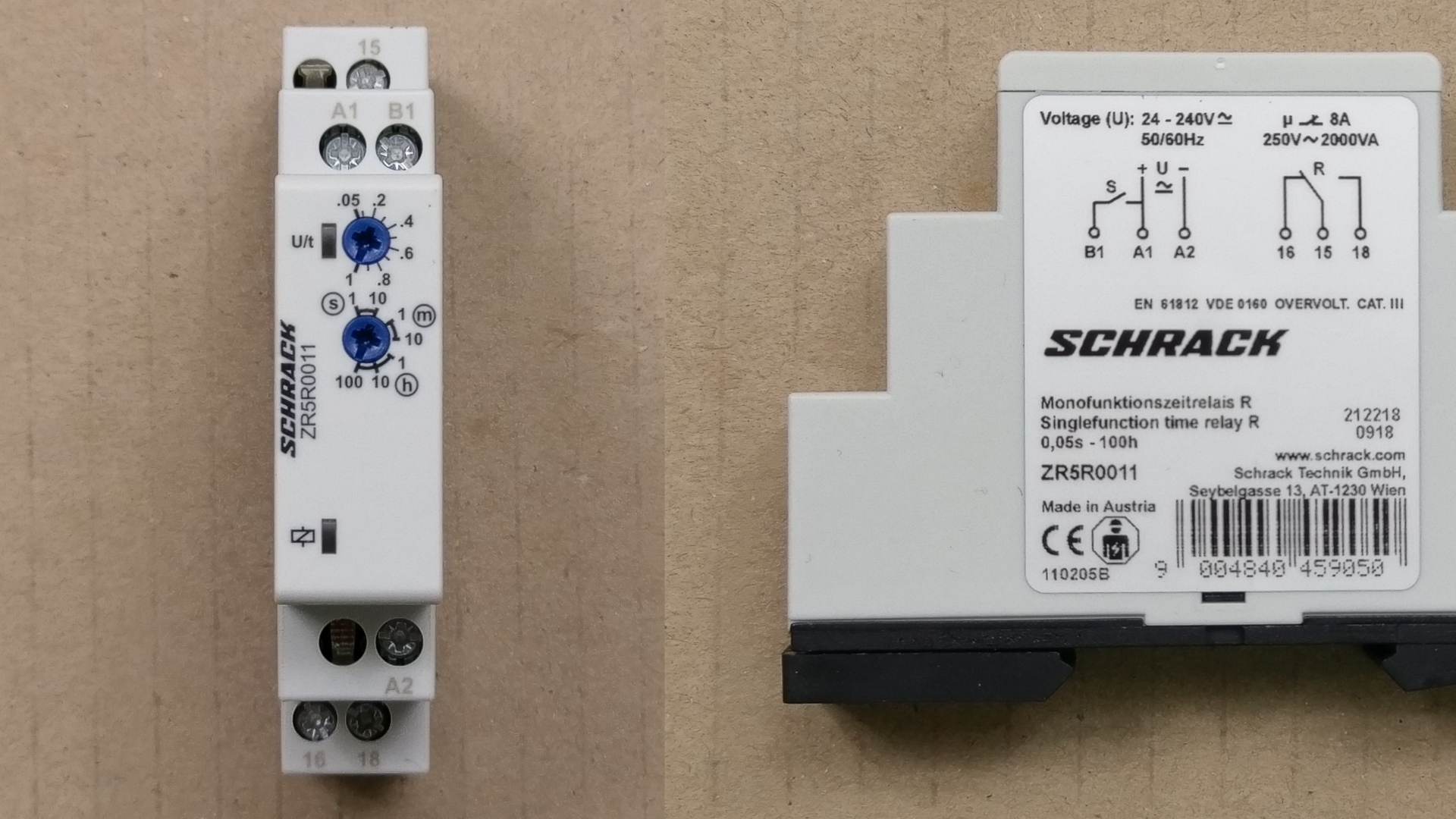
An off delay relay is an electrical switching device that requires a certain amount of time to elapse before its output contact will be switched off. The relay will switch its output contact on as soon as a start signal is given. But when the start signal is removed, the output contact will still stay on for a period of time. Once the predetermined delay time has elapsed the output contact will then turn off.
How It Is Used

Check out this electrical diagram of an off delay used in a motor control circuit, you can clearly see the “relay” and its “contact”. In this example if the start button was pressed this would provide power to terminal B1 which is the (start) signal. The contact T1 would close immediately which would power up K1 and thus would send power to the motor. If the finger was then taken away from the start button, power would no longer be at B1 and T1 would then start timing out. Once T1 had timed out, the contact of T1 would open, K1 would lose power and the motor would lose power as well.
Quick Tip
Notice that the T1 contact looks like a parachute! It is handy to remember that the parachute drawn on any contact will show that the contact will have a delay in the direction of the parachute. Just the same way that a parachuters descent to the ground from a plane is slowed by a parachute.
To Recap
An off delay relay is an electrical component that switches its output contact on as soon as it receives a start signal, it then delays the output contact turning off when the start signal is removed.
Learn more
Fundamentals of Electrical Controls
3 Phase Motor Control Bootcamp
Learn Variable Frequency Drives