
The control voltage of an electrical installation is the voltage that is used to control the electrical components of a control circuit. These components can be contactors, relays and indicator lights. The voltage that is supplied to a motor or large heating element would not be considered control voltage, although in some cases the same voltage is used.
Different Control Voltages
In the above diagram we can see that the control circuit on the right is supplied by L1 from the power circuit. This voltage is 240 volts AC, and this means that all the control components need to be rated for 240 volts AC as you can see is the case in the bottom right hand corner of the diagram.
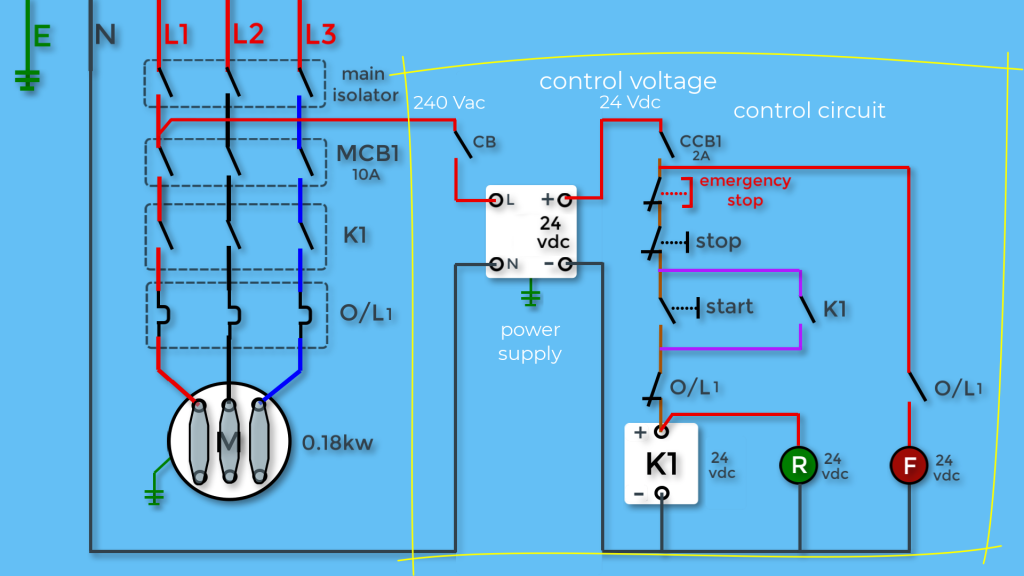
In this next schematic you can see that the actual control wiring is basically the same as before. But, now there is a power supply installed which powers the controls. The voltage coming out of the power supply is 24 volts DC which now means that all the components in the control circuit need to be rated for 24 volts DC.
Reasons For Different Voltages
Different electrical circuits may use different voltages for many different reasons. One reason that a lower voltage such as 24 volts might be used for controls is that it’s less dangerous if the control wiring is running out to the field. If there is a break in the cable someone is less likely to get an electric shock from 24 volts as opposed to 240 volts or higher.
One reason for using a higher voltage than 24 for our controls is current. If you had a large electrical panel with lots of components such as contactors and indicator lights, the more components you have the more current they will draw when energised. If they were running off a 24 volt power supply, that power supply would have to be big enough to be able to provide power to all those components. But if you used a higher mains voltage such as 240 volts, the current or power drawn by the components would be much lower.
To Recap
The voltage that runs through the control circuit may be different in different installations, but the components within the circuit must be rated for whatever voltage is connected to them.
Learn more
Fundamentals of Electrical Controls
3 Phase Motor Control Bootcamp
Learn Variable Frequency Drives